

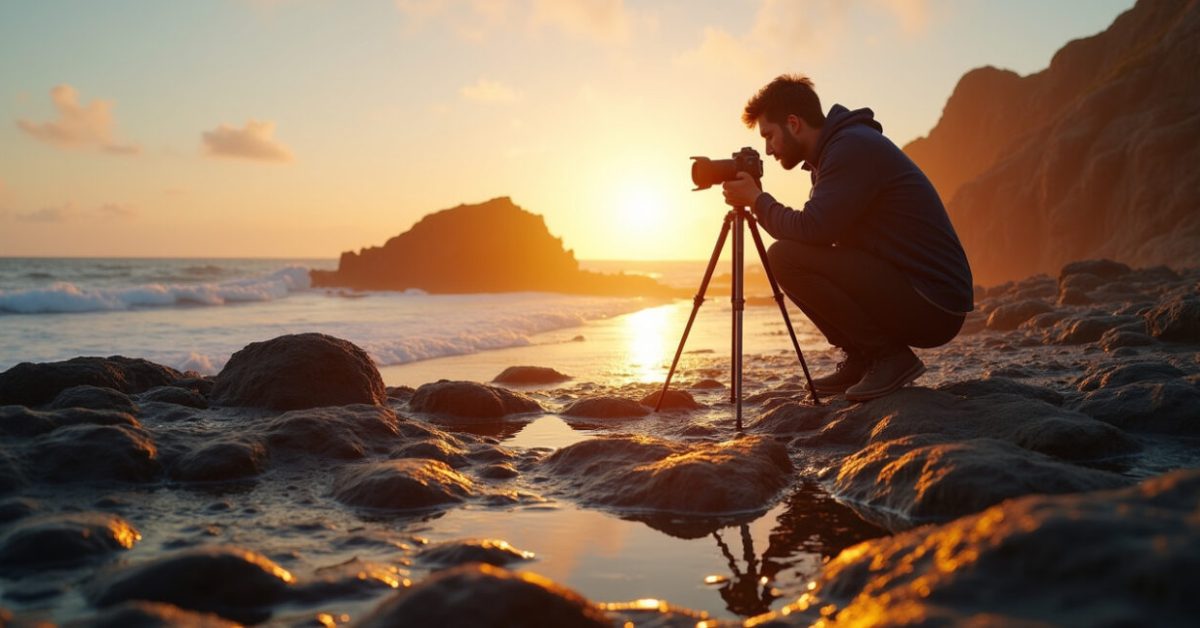

The horizon is sharp, the foreground rocks scream detail, and the sky still looks natural — even though you used a wide-angle lens. That balance is the trick most landscape shooters never fully learn. Keep reading; you’ll get concrete focal choices, simple fixes for distortion, a focus-stacking workflow that actually fits a sunrise, and composition rules that keep foregrounds dominant without bending the world into a fisheye.
Why a Wide-angle Lens is Not Just “wider” — It Changes How You See
A wide-angle lens reshapes depth and scale, and that’s its real power. It exaggerates the distance between near and far. That can make a tiny puddle feel monumental, or turn a ridge into the lead actor of the frame. But the same trait can ruin a shot: horizons that look curved, people with stretched features, or a busy foreground that steals the show. Knowing what the lens does to depth is the best way to use it, not fight it. When you control scale, the viewer feels transported.
Which Focal Lengths Actually Work for Landscapes (and Why)
Stop guessing focal numbers. For full-frame shooters, 16–35mm covers most needs. Use 16–20mm when you want drama in the foreground; 24–35mm to preserve natural horizons and reduce distortion. Crop sensors shift those to roughly 10–22mm and 16–24mm. Prime wide-angle lenses often give cleaner edges and sharper centers than zooms, but modern 16–35mm zooms are versatile and sharp enough for most trips. Choose based on the subjects you chase: intimate rocks vs grand vistas — they ask for different fields of view.

The One Distortion Trick That Fixes 90% Of Bad Horizons
Lens and perspective distortion are different beasts. The clean fix for horizon problems is simple: keep the camera level, then correct small tilts in post. For more stubborn barrel or pincushion distortion, use lens profiles in Lightroom or Capture One. But don’t overcorrect — that’s what makes clouds stretch or cliffs lean. If straight lines still look wrong, switch to a slightly longer focal length or step back and crop. Often the best correction is a small physical move, not a heavy software warp.
Focus Stacking for Landscapes Without Turning It Into a Chore
Here’s a workflow that fits a sunrise: set tripod, compose with wide-angle lens, focus near (1/3 into scene), take the base frame, then shift focus to mid and far, two more frames. Three shots are often enough. Use f/8–f/11 to avoid diffraction and keep shutter speed practical. Stack in Lightroom or Helicon Focus, then blend with a masked exposure for the sky if needed. This method keeps foreground texture crisp and distant details intact without forcing you to wait for perfect windless conditions.
Composition Rules That Keep Foregrounds Strong and Horizons Believable
Don’t let a wide-angle lens make everything fight for attention. Start with a dominant foreground element and make it unmissable. Use leading lines, low camera height, and a strong silhouette. Place the horizon on the top or bottom third — not the center — unless you have a deliberate mirror or symmetry. When the foreground is textured and large, the eye won’t be tricked by mild horizon curvature. Negative space works too: let the sky breathe if it’s interesting, and tighten if it’s not.
Common Mistakes Photographers Make with a Wide-angle Lens (and How to Avoid Them)
People repeat the same errors: shooting too close without considering distortion, stopping down so far that diffraction kills sharpness, and trimming edges blindly in crop. What to avoid:
- Shooting at f/22 for depth — use focus stacking instead.
- Putting the horizon dead center out of habit.
- Fixing perspective with extreme warps in post.
- Ignoring foreground texture — it’s the scene’s anchor.
A Quick Kit Checklist and When to Upgrade
Buy gear that helps you execute, not impress. Essentials: a sturdy tripod, a 16–35mm or equivalent wide-angle lens, a circular polarizer, and a remote release. Add a nodal slider if you pano-stitch or do close foreground stitching. Upgrade lenses when you need less edge softness and better flare control — not because someone said a brand is “pro.” Rent before you buy: test a prime 20mm and a 16–35mm zoom back-to-back on real scenes. Your eye will tell you which fits your style.
Comparison — expectation vs reality: you expect a single wide shot to capture everything. Reality: a tight workflow (tripod, 3 stacked frames, mild corrections) gives a cleaner, more dramatic result than a single “do it all” exposure. The extra effort is small. The payoff is huge.
For technical reading and accepted distortion correction practices, check the lens profile documentation at Adobe Lightroom. For depth-of-field and diffraction science, see research summaries hosted by universities, such as at Stanford.
Final Thought to Keep You Shooting Smarter, Not Harder
Wider isn’t always better, but when you use a wide-angle lens with intent, the images gain presence. Make small moves in the field. Stack when necessary. Correct subtly. The landscape will give you better photos — and keep you wanting more.
How Close Can I Get to the Foreground with a Wide-angle Lens Without Distortion Ruining Faces or Objects?
You can get very close and keep pleasing results, but be mindful of perspective. With a wide-angle lens, objects near the camera appear disproportionately large compared to the background. For faces, avoid placing a person within a foot of the front element; instead, step back and crop or use a less wide focal length. For inanimate foreground elements like rocks, get close to emphasize texture, then use focus stacking to hold sharpness across the frame. Small physical moves often beat digital fixes.
When Should I Choose a Prime Wide-angle over a Zoom for Landscape Work?
Choose a prime when you want maximum edge-to-edge sharpness and lower distortion in a specific focal length. Primes generally have fewer optical compromises, better low-light apertures, and cleaner rendering. Use a zoom when flexibility matters — changing composition without repositioning is huge on cliffs or in bad weather. If you travel light and shoot quickly, a sharp 16–35mm zoom is often the best practical choice. Rent a prime first to see if its look suits your style.
What Aperture is Best for Wide-angle Landscapes to Balance Depth and Sharpness?
For many wide-angle landscape situations, stop down to f/8 or f/11. This range gives you good depth and avoids diffraction softening that appears at very small apertures like f/22. If you need everything pin-sharp from foreground to infinity and the scene allows, use a focus-stacking approach with each frame shot around f/8–f/11. That way you gain depth without sacrificing corner detail. Remember to check shutter speed and ISO to keep noise low.
How Do I Correct Horizon Curvature Without Making the Sky or Cliffs Look Warped?
First, keep the camera level in the field — that prevents most curvature. If slight curvature remains, use a lens profile correction in your raw processor rather than aggressive free-transform tools. When you must straighten more, apply subtle corrections and then crop to remove edge artifacts. If the sky or cliffs start to look warped after correction, undo a bit and instead try a slightly longer focal length or a different shooting position to reduce the need for heavy correction.

Is Focus Stacking Worth It for Windy Conditions or Moving Elements Like Grass and Water?
Focus stacking can struggle with moving elements because alignment and blending assume static scenes. For windy grass or rippling water, use a narrower aperture and accept a bit less absolute depth, or wait for calmer moments. When the foreground is critical and wind is predictable, try stacking short bursts and discard frames with motion issues before blending. Alternatively, shoot a single exposure at a mid-aperture and rely on composition and texture to read as sharp. Stacking is powerful but not always practical on restless days.