

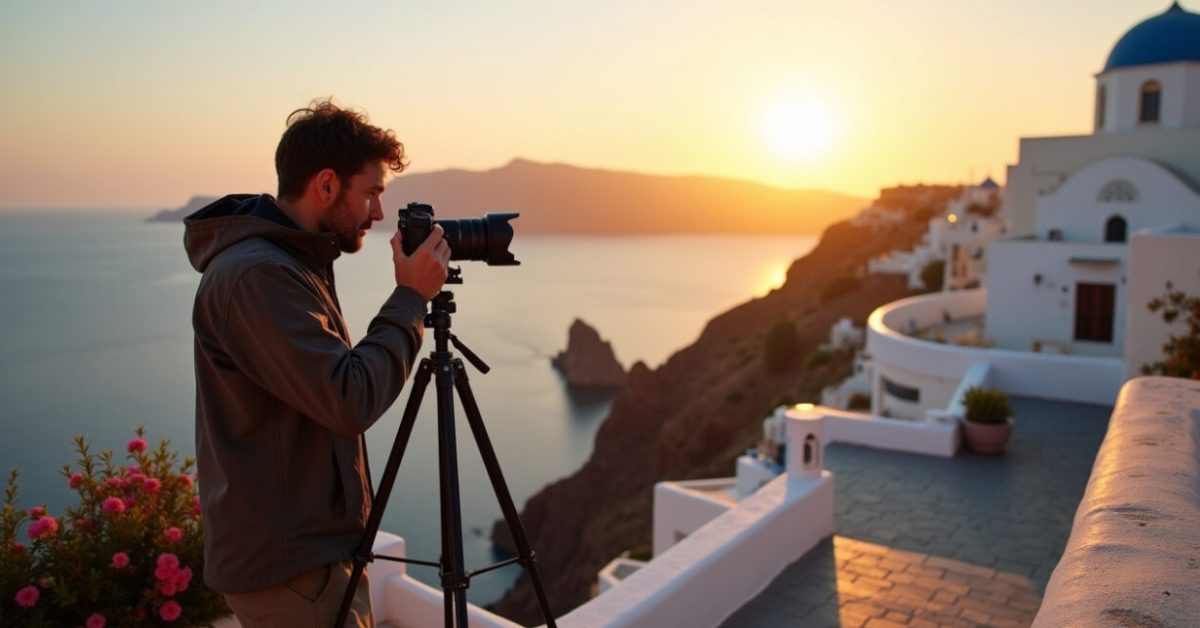

The sky over Oia suddenly goes from pale blue to molten copper. A church dome glows like a gold coin. In that ten-minute window, Santorini photography can make you look like a pro — or like everyone else’s feed. This guide gives the exact vantage points, the best minutes to shoot, lens and exposure choices, and sneaky crowd hacks that yield cleaner, more dramatic compositions.
Why the Five Minutes Before Sunset Matter More Than the Sunset Itself
The light that matters in Santorini photography often arrives before the sun actually touches the horizon. Twenty minutes before sunset the caldera bounces warm light from below, the domes catch low-angle glow, and shadows gain texture. Expect a short, explosive window where colors shift fast. Aim to be set up 30 minutes early. Walk your frame, lock focus, and shoot test exposures. That way you’ll catch both the soft prelude and the peak color, not just the final orange drop.
The Three Vantage Points That Produce Postcard-to-epic Shots
Santorini photography rewards position. These three spots deliver consistent results.
- Oia Castle & nearby alleys — Classic domes and sea layers; great for wide to medium lenses.
- Fira cliffs toward Imerovigli — Higher, cleaner lines, better for telephoto compression and sunset arcs.
- Akrotiri Lighthouse — Rugged foregrounds and a quieter horizon; ideal for long exposures.
Each spot needs a slightly different setup. Scout early and pick one primary and one fallback. Santorini photography is about choosing frames as much as catching light.

The Exact Minutes and Tides: When to Arrive and Why
Arrive early. Too many photographers assume “sunset time” is enough. For Santorini photography, plan like this: arrive 60 minutes before official sunset, be framed and metered by 30 minutes before, and take your critical shots in the 20-to-5-minute-before window. Check local sunset time, but also watch wind and cloud cover. Weather data from reliable sources such as National Geographic can help predict dramatic skies.
Lens and Exposure Choices That Actually Work (and Why)
Use the right tools for the story you want to tell. For Santorini photography, start with a 24–70mm for flexibility. Add a 70–200mm for compressed, layered sunsets and a 16–35mm for dramatic foregrounds and wide seascapes. Exposure: shoot in RAW, bracket ±1.5 stops, and favor -1/3 EV to preserve highlights. For long exposures of smooth sea after sunset, use ND filters and a sturdy tripod at 5–30 seconds depending on wind. ISO 100–200 keeps detail clean.
Composition Secrets: Foreground, Lines, and the “quiet Frame”
Great Santorini photography is not just color; it’s structure. Use white steps, walls, and railings as leading lines toward the sun or dome. Place a foreground silhouette (a stair, a sign, a person) to add scale. The “quiet frame” is your cheat: wait for a lull in foot traffic or use a 2–3 second exposure to blur moving tourists into soft shapes. Expect to shoot many frames; the quiet one rarely appears on the first try.
How to Avoid Tourist Crowds and Get Cleaner Shots
Crowds ruin many otherwise-perfect Santorini photography moments. Here’s a short list of tactics that work:
- Arrive 60 minutes early and position yourself above the main path.
- Use alleys and side terraces — often 50 meters off the main viewpoint is calmer.
- Shoot during shoulder season (April–May or late September–October) for fewer people and better light.
- Employ a small neutral-density filter to allow longer exposures that soften moving crowds.
A quick comparison: expectation — packed ledge full of phones; reality — a single silhouette framed against the sun because you moved 30 meters uphill. That small change transforms an average travel photo into memorable Santorini photography.
Common Mistakes, Fixes, and a Quick Real-life Example
People make the same mistakes over and over: wrong exposure, cluttered foregrounds, and waiting at the wrong minute. Fix them by bracketing exposures, swapping lenses before the crucial light, and scouting escape routes from the main viewpoint. Three nights ago, I watched a photographer chase a perfect sunball from spot to spot and miss the best colors because he was always framing. He moved back to a quiet rooftop, stabilized his tripod, and in five minutes captured a frame that beat his previous dozen. Small choices matter.
For background reading on light and exposure standards, see the U.S. National Weather Service for sunset timing norms and the Hellenic Ministry of Culture for local site rules: weather.gov and culture.gov.gr.
Parting Prompt: What Will You Change on Your Next Trip?
Don’t leave your next Santorini photography session to chance. Pick one vantage, pick one lens, pick one composition, and protect it for the ten minutes that matter. That single disciplined decision will turn a photo you forget into one you keep.
When is the Best Month to Shoot Santorini Sunsets?
The best months for Santorini photography are April–May and late September–October. These shoulder months offer milder crowds, clearer air, and warm light with fewer heat haze problems than July–August. Tourist density drops substantially, which gives you time to set up and try different exposures. Weather is also more stable than winter storms. If you can, aim for a new moon period for cleaner night skies after sunset. Book accommodations early; the best rooftops go fast in these ideal months.
Which Camera Settings Should I Start with for a Sunset?
Begin with RAW, ISO 100, aperture f/8–f/11 for sharpness, and shutter speed that matches light — often 1/60 to 1/250 as the sun approaches. Bracket ±1.5 stops and check histograms to protect highlights. For creative long exposures after sunset, switch to ISO 100, f/11–f/16, and 5–30 seconds with an ND filter if needed. Use manual focus or back-button AF on a locked tripod. These starting settings let you refine quickly while light shifts.
How Do I Frame a Shot to Avoid Crowds Without Photoshopping People Out?
Frame low or high to exclude busy walkways. Use alleys, terraces, or rooftops offset from main viewpoints. Place large foreground elements (walls, stairs, benches) between you and clusters of people so they’re out of frame. If people still move through, use a 1–3 second exposure on a tripod to blur them into ghostly motion. Alternatively, shoot burst sequences and pick frames with minimal people. These tactics keep Santorini photography authentic without heavy editing.

Which Lenses Are Essential If I Only Bring Two?
If you must choose two lenses for Santorini photography, take a wide zoom (16–35mm or 24–70mm) and a tele zoom (70–200mm). The wide covers dramatic foregrounds, architecture, and intimate alley scenes. The tele lets you compress layers, isolate domes, and capture distant sun arcs. Both allow fast switching to adapt to quick light changes. Pack filters, a small tripod, and a lens cloth — salt spray and dust are real on the caldera.
Can I Shoot Handheld at Sunset, or Do I Need a Tripod?
Handheld works early and during brighter moments, but a tripod is essential for the peak color window and for long exposures after sunset. A tripod stabilizes bracketed frames for HDR, permits low ISO long exposures, and lets you use slower shutter speeds to render water and moving crowds artistically. Lightweight travel tripods that clamp to railings or sit on uneven terraces are ideal. Bringing one gives you creative options without weighing you down.