

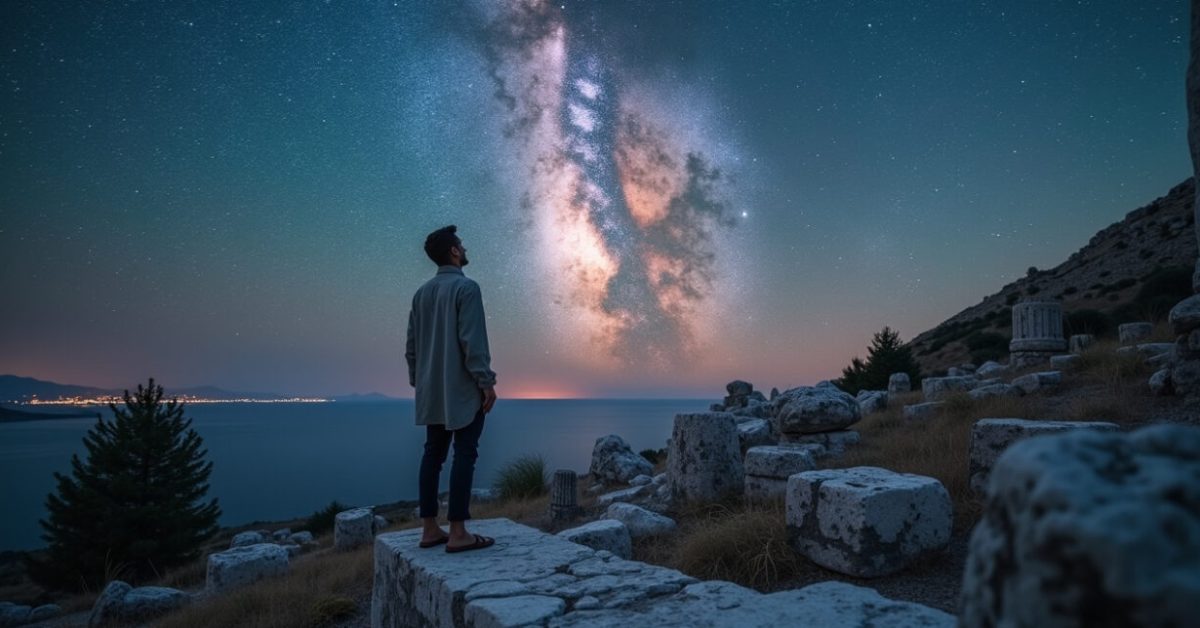

A beam of the Milky Way spilled across white-stone ruins, and I stayed frozen until the town lights blinked out. That’s the power of the night sky Greece can give you: ancient stones, absolute darkness, and a galaxy arcing overhead. If you want one photo that makes friends pause their scroll, this guide gives the exact months, the dark-sky spots, camera settings, and simple composition tricks to nail those astro-landscapes.
When to Go: The Best Months for the Milky Way over Greece
Late April to early October is your window for the Milky Way in Greece. The bright core becomes visible after midnight from April, peaks in June–August, and stays impressive into early October. Winter nights are long and crisp but the Milky Way core is below the horizon. For the sweet spot: plan May–September for warm nights and fewer clouds; June–August gives the highest core position.
Night sky Greece behaves differently by latitude: islands like Crete see the core higher than northern mainland spots. Also check moon phases — a new moon night is non-negotiable if you want the Milky Way to pop.
Where to Go: Seven Dark-sky Spots That Actually Deliver
Not all “remote” places are dark — some are just far from town and still bright. Here are proven spots where night sky Greece looks cinematic:
- Mt. Parnassus foothills (mainland) — high elevation, little haze.
- Monemvasia peninsula — ruins right on the coastline.
- Elafonissi, Crete — pink sand and minimal light pollution.
- Karpathos interior villages — truly dark, local hospitality.
- Samothrace hills — raw foreground geology.
- Ikaria west coast — dramatic cliffs and horizon views.
- Peloponnese interior (near Andritsaina) — old temples plus dark skies.
Check dark-sky maps and local restrictions; some archaeological sites close at night. For official light-pollution data, see the Light Pollution Map.

How to Pick Foregrounds: Ruins, Coastlines, and What Actually Works
Foreground choice makes or breaks the shot. Ruins add scale and story; coastlines give horizon lines and reflections. The trick: pick a simple silhouette, not a busy ruin. One broken column, one arch, one shoreline curve. Balance is more important than “pretty.”
Composition tips:
- Place the Milky Way off-center to pair with an arch or column.
- Use a low angle to include more sky above ruins.
- On the coast, time low tide for foreground texture and reflections.
Camera Settings That Actually Work for Milky Way Shots
Start with these baseline settings and adjust to taste. Use a full-frame camera if you can, wide lens 14–35mm, aperture f/1.4–f/2.8, ISO 1600–6400, shutter 10–25s depending on focal length. Use the 500/400 rule: 500 ÷ focal length (full-frame) gives max seconds before star trails.
- Manual focus: focus at live-view infinity on a bright star.
- Shoot RAW, turn off long-exposure noise reduction.
- Bracket exposures: one for sky, one for foreground (light-painted or exposure-blended).
Lighting the Foreground Without Ruining the Stars
Subtlety wins: a touch of light paints the ruins, not bleaches them. Use a dim LED panel (20–50% power), brief hand-held flashes, or a headlamp with a warm gel. Light from the side creates texture. Avoid continuous bright light aimed at the sky — it kills the Milky Way contrast.
Common approach: expose for the sky, then do a 20–40 second low-power paint pass on the foreground. Combine in post or use two exposures blended in-camera if available. This keeps the stars crisp and the ruins readable.
What Most People Get Wrong (and How to Avoid It)
Expectation: one epic shot per location. Reality: planning and patience make five good frames. Common mistakes:
- Going during a bright moon — the Milky Way washes out.
- Using too-narrow a lens — you lose context.
- Over-lighting the foreground — you end up with flat, fake-looking ruins.
- Ignoring weather and humidity — coastal haze kills detail.
Fixes: check moon phase, pack a wide fast lens, practice light painting, and watch humidity forecasts. For reliable weather and cloud cover, consult the Hellenic National Meteorological Service.
A Small Night: A Quick Field Story That Teaches Composition Faster Than Tutorials
I climbed a side road to a half-ruined temple at 1 a.m. The Milky Way was a ribbon, but the column cluster was cluttered. I walked thirty meters, found a single broken column against the horizon, and waited. Two cars passed and left orange streaks. I took three frames: sky, painted foreground, and a low exposure for sea glow. Back home, the blend gave depth and mood. The single column against the Milky Way made the shot.
Now go map a site and pick one ruin or shoreline curve. Two good nights are better than ten rushed ones. The night sky Greece rewards patience and simple choices.
Will you choose ruins or the sea for your first Milky Way frame?

When is the Best Time of Year to Photograph the Milky Way in Greece?
For most of Greece, the best months are from late April through early October. During this period the Milky Way core rises high enough to be visible after midnight, with June through August providing the clearest and most central views. Plan around a new moon for the darkest skies, and avoid heavy summer haze near the coast. Check local sunrise/sunset and moon charts to pick nights when the core is highest and darkest for your chosen location.
What Camera Gear Do I Absolutely Need for Night Sky Greece?
Essentials: a camera that can shoot RAW, a fast wide-angle lens (14–35mm) with aperture f/1.4–f/2.8, and a sturdy tripod. Add a remote shutter or intervalometer to avoid shake, and a headlamp with a red mode for safe navigation. Optional but helpful: a star-tracking mount for longer exposures, an LED panel for light painting, and spare batteries (cold nights drain them). Renting a full-frame body and a fast lens is a good budget move.
How Do I Compose the Milky Way with Ruins Without Over-lighting Them?
Keep the foreground exposure subtle. Expose the sky first, then use a separate low-power light-painting pass for 20–40 seconds at reduced brightness. Light from the side creates texture; gel the light warm to match sodium lamps if present. Use two exposures and blend in editing to preserve star detail. Avoid long, bright continuous lights pointing at the sky, and check the result on your camera’s histogram to make sure you haven’t clipped highlights.
Are There Legal or Cultural Restrictions Shooting Ruins at Night in Greece?
Yes. Many archaeological sites close after sunset and require permits for photography, especially for commercial use. Local rules vary by site and region. Always check opening hours and contact the site office or local municipality if you plan to enter after hours. Respect fenced areas and do not climb fragile structures. When in doubt, choose nearby dark locations or private land with permission; local guides can often arrange lawful access and safer night shoots.
How Do I Plan Around Weather, Moon, and Light Pollution Effectively?
Use three tools: a moon phase/calendar to pick new-moon windows; a cloud-cover forecast (hourly) to avoid clouds; and a light pollution map to find dark zones. Plan a backup night within the same trip in case of clouds. Coastal humidity can create haze, so inland high-elevation spots often yield sharper skies. Monitor forecasts up to the last hour — mountain breezes and sea fog can change quickly — and keep flexible with timing to catch short clear windows.