

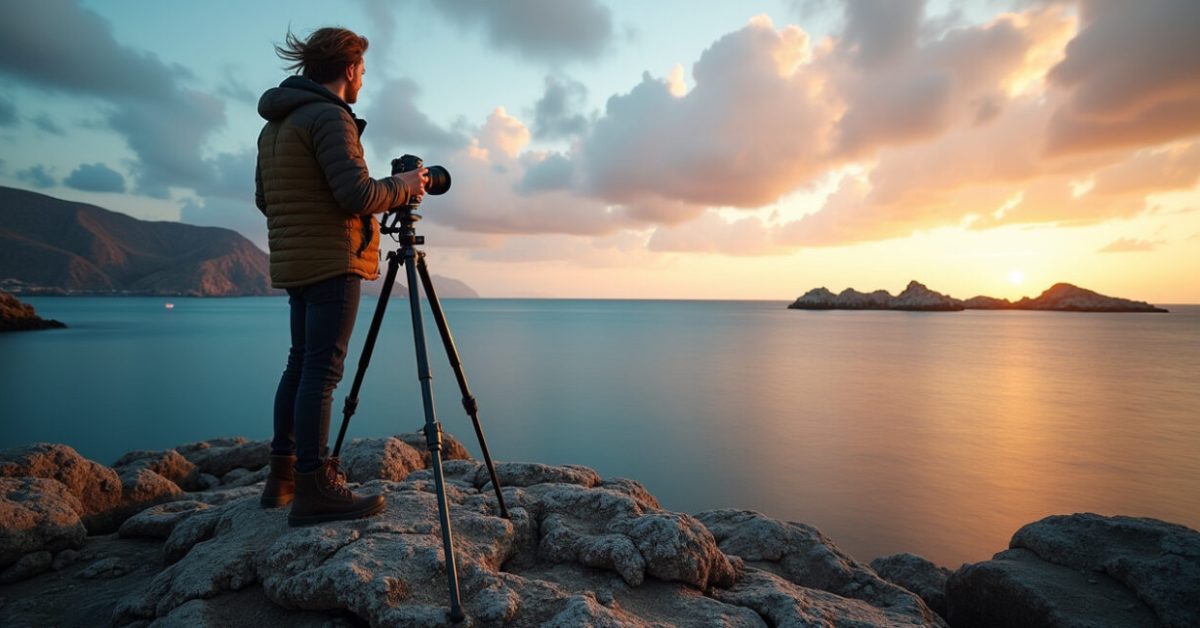

Salt spray on your boots, a wind that keeps moving, and a sea that refuses to sit still — yet your camera shows glass-smooth water and ribboned clouds. That’s the quiet magic of long exposure Greece: turning restless Aegean scenes into calm, cinematic frames. Read on for shutter speeds, filters, tripods, and composition tricks that work with Greek light and wind, not against them.
The Shutter-speed Rules I Break Every Time in Greece
There is no single “right” shutter speed for long exposure Greece. The Aegean, Ionian, and Mediterranean near Crete behave differently. I often start at 1–2 seconds on a bright day to tame small waves, then push to 10–30 seconds for silky seas and streaked clouds. For full-motion cloud painting, 60–180 seconds is where the drama happens—but only with the right filters and a stable tripod.
- 1–2s: gentle smoothing, keeper for hand-timed shots
- 5–30s: classic silk-water look around piers and rocks
- 60–180s+: sweeping clouds and near-mirror seas at dusk
Filters That Survive Greek Sun and Still Give That Glass Look
ND filters are your best friend in Greece — variable ND for flexibility, solid ND for quality. Coastal light can be brutally bright at noon. A 6–10 stop (ND64–ND1000) will let you shoot 10–30 seconds even in strong daylight. Add a subtle 0.9–1.2 soft grad when the horizon is bright to keep details in the sky without blocking the sea.
- Start with a 6-stop for golden hour experimentation.
- Use a 10-stop for daytime long exposures of choppy water.
- Polarizers help reduce reflections but stack with care to avoid vignetting.

Which Tripods Actually Hold Up on Rocky Greek Shores
A flimsy tripod ruins more shots than any wrong shutter speed. Choose a tripod with a low center of gravity, thicker legs, and a hook for hanging weight. Carbon fiber is light, but aluminum with beefier legs can handle gusty cliff-top winds better. Bring heavier ground stakes or sandbags for pebble beaches and tie-down points when possible.
- Look for leg-locks that you can tighten with cold or wet hands.
- A tripod head with smooth panning helps with precise composition between exposures.
Composition Secrets — Make Choppy Water Readable
Long exposure Greece is not about motion blur alone; it’s about turning chaos into leading lines. Use rocks, jetties, or swim ladders to anchor the foreground. Low angles amplify water texture turning ripples into soft currents that lead the eye. Prefer simple horizons and negative space where streaked clouds can breathe.
- Foreground anchor + midground interest + open sky = balanced long exposure.
- Try a 30° camera tilt to exaggerate wave flow into your anchor point.
The One Comparison That Changes How You Shoot in Greece
Expectation: 5-second exposures will always look dramatic. Reality: a 5-second shot of a busy harbor can be a gray mess. Compare a 5s and a 60s shot of the same scene: the 5s shows texture but still looks busy; the 60s turns boats into gentle ghosts and clouds into ribbons. The right duration depends on subject speed and intent, not on a preset rule.
| Subject | Suggested Range | Effect |
|---|---|---|
| Rocky shore, small waves | 5–20s | Smooth water with texture |
| Open sea, fast clouds | 60–180s | Streaked sky, glass sea |
| Harbor with boats | 1–5s or 120s+ | Either frozen detail or ghosted movement |
Common Mistakes and How to Avoid Them on Greek Shoots
Most errors are avoidable with one habit: slow down between frames. Here are the frequent slip-ups:
- Ignoring wind — tripod tip: add weight and lower the center of gravity.
- Using too much ND without checking focus first — focus before you mount the filter.
- Cluttering the frame — remove distracting objects or change angle.
- Not bracketing exposures — take multiple durations to choose later.
One quick rule: always shoot a short exposure and then the long one. You’ll preserve sharp reference details and save time later.
Local Tweaks — Adapting Technique to Greek Locations and Light
Each Greek island and coast has microclimates that affect exposure choices. Santorini’s reflective caldera needs fewer stops than shaded coves in Corfu. In windy Mykonos expect more boat movement; crank shutter time higher or embrace ghost boats at 120s. Scout at golden hour and note cloud direction; a 30-minute wait often yields a superior sky.
When possible, check local tide charts and sunrise/sunset times. For technical context, official meteorological data from the Hellenic National Meteorological Service can help plan shoots (hnms.gr), and basic tidal patterns are explained by university coastal studies like those at the National Technical University of Athens (ntua.gr).
Mini-story: On a windy evening at a small Peloponnesian pier, I set a 10-stop ND and aimed for 90 seconds. I thought the shot would be soft. Instead, rocks carved clean foreground lines and clouds painted into ribbons across the sky. Two locals watched, then applauded when I showed them the back of the camera. The scene felt familiar to them; the photo made it new.
Next Move: What to Pack for a Long Exposure Greece Day
Pack like you plan to stay until the light changes. Essentials: sturdy tripod, 6–10 stop ND, polarizer, lens cloths, remote shutter, and a weight hook or sandbag. Add spare batteries and a small flashlight for twilight adjustments. If you plan multi-minute exposures, bring a lens hood and a timer app to track exact durations.
Final thought: long exposure Greece is a conversation with the sea and sky. Sometimes you lead, sometimes you follow. Learn the local rhythm, and the results will surprise you.
How Long Should I Expose the Sea on a Bright Greek Afternoon?
On a bright afternoon, start with a 6–10 stop ND filter to reach exposure times between 10 and 30 seconds. That range smooths choppy water while preserving some texture around rocks and piers. If clouds are fast and you want streaks, increase to 60 seconds or more, but test carefully: brighter skies may require a 10+ stop filter to avoid overexposure. Always make a short reference shot before committing to long exposures.
Can I Use a Variable ND for Long Exposure Greece Shots?
Yes, a variable ND is useful for quick changes in light, but it has caveats. At high densities it can cause uneven polarization or cross-patterns, especially with wide-angle lenses. For exposures longer than 30 seconds, a solid (fixed) ND of 6–10 stops usually yields cleaner results. Use a variable ND for scouting and minor adjustments, then switch to a solid ND when you lock in the composition for multi-minute exposures.

What Tripod Features Matter Most on Windy Greek Cliffs?
Stability, weight hook, and leg-lock reliability matter most on windy cliffs. Choose a tripod with a low center of gravity and thicker legs to resist gusts. A hook under the center column lets you hang a bag or sandbag for extra damping. Quick-release plates and a ball head that locks firmly make composition changes faster, but avoid lightweight compact tripods when wind is strong—heavier, sturdier models reduce vibration and lead to sharper long exposures.
How Do I Focus When Using Thick ND Filters in Greece?
Focus before attaching the thick ND filter. Use live view and magnify the image to nail focus on a rock or other high-contrast point. Once focused, switch to manual focus to avoid hunting during the long exposure. If you must focus after the filter is on, use a torch to illuminate the subject briefly, focus, then turn the torch off and expose. This technique preserves sharpness even with multi-minute exposures and heavy filtration.
What Are Quick Composition Fixes When the Sea Looks Messy?
If the sea looks messy, simplify the frame: move closer to a foreground anchor, lower your shooting angle, or crop out busy elements. Extend your shutter time to blur competing textures into smoother planes. Another fix is to change focal length—wider lenses can compress movement into pleasing sweeps, while telephoto crops isolate calm sections. Small adjustments often transform a chaotic scene into a calm, cinematic image.