

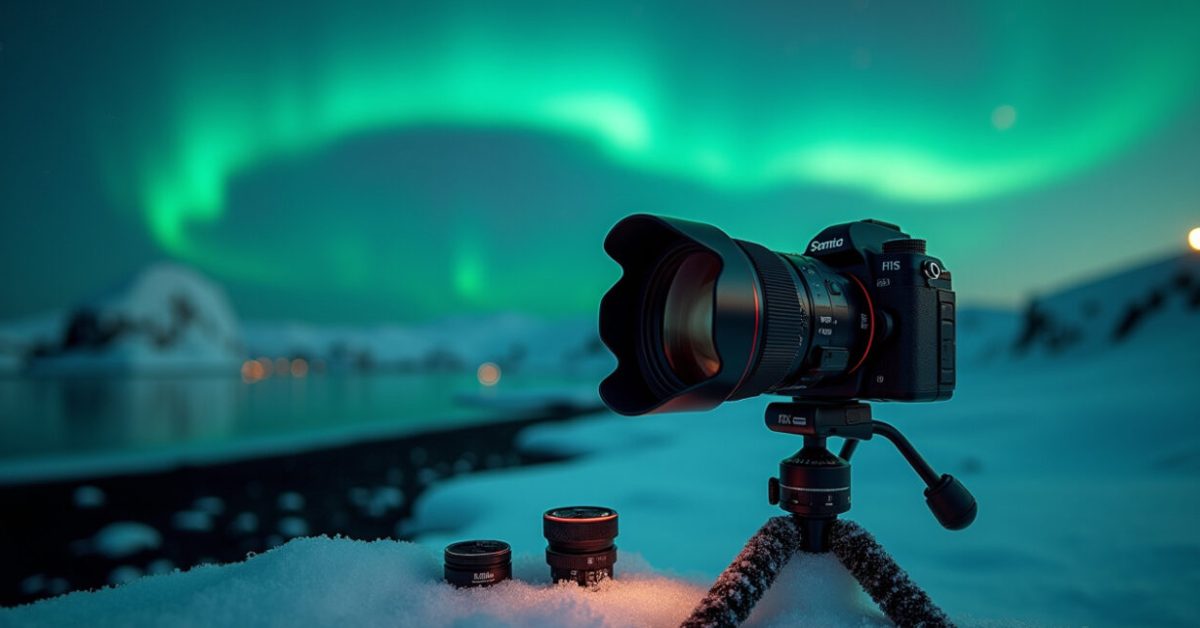

Chasing the aurora in a frozen wonderland demands more than intuition — it requires precise Iceland camera settings to turn fleeting green curtains into unforgettable frames. If you’ve ever stood beneath a vault of stars and felt the urge to capture that moment, this guide is for you.
Today, mirrorless sensors, fast wide-angle lenses, and careful exposure control make night and low-light photography in Iceland more accessible than ever. I’ll walk you through practical settings, gear choices, and on-the-spot tweaks to nail the aurora, waterfalls at dusk, and glacier-lit nights.
Essential Gear and Preparation for Iceland Nights
Choose the Right Camera and Lens
Start with a mirrorless or DSLR with good high-ISO performance and raw capture. Use a fast wide-angle lens to capture broad skies and foreground context.
A 14mm–24mm f/2.8 lens excels for aurora and landscape. Bring a second prime for creative close-ups and low-light portraits.
Tripod, Remote, and Accessories
A sturdy tripod prevents shake during long exposures; a remote or intervalometer prevents camera movement. Pack extra batteries—the cold drains power fast.
Use lens heaters or hand warmers to avoid condensation. Carry a headlamp with a red light to preserve night vision while adjusting settings.
Core Iceland Camera Settings for Aurora and Low Light
Baseline Exposure Settings
Begin at 14mm, f/2.8, 15s, ISO 1600 on a mirrorless body for bright aurora. Adjust shutter speed shorter if the aurora moves quickly.
For dimmer displays, increase ISO to 3200 and shorten focal length. Balance aperture, shutter, and ISO to minimize star trailing and noise.
Focus, White Balance, and Noise Control
Set manual focus to infinity and fine-tune on a bright star or distant light. Use native ISO for less banding, and capture in RAW for white balance tweaks later.
Enable long-exposure noise reduction sparingly; it doubles processing time. Instead, bracket shots and use noise reduction in post-processing for more control.
- Use mirrorless bodies for live view focusing and low-light preview.
- Prefer fast primes or constant f/2.8 zooms for flexibility.
- Bring ND filters for daylight glacier shots and polarizers for wet landscapes.

Techniques to Capture Dynamic Auroras and Starfields
Short Vs. Long Exposures
Short exposures (4–8s) freeze fast aurora arcs and preserve star shapes with wider focal lengths. Longer exposures (15–25s) smooth faint curtains but may trail stars.
Test a sequence: 6s, 10s, 15s to see how motion renders. Adapt according to focal length and aurora intensity to retain detail without blur.
Layering Foregrounds and Sky
Compose with a strong foreground element—ice, a waterfall, or a lone hut—for depth. Use exposure blending to retain foreground detail while keeping sky texture.
Take a longer exposure for the foreground at dusk or use a low-level LED to paint light for a balanced composite that feels natural and cinematic.
Practical Step-by-step Shooting Workflow
Pre-shoot Checklist
Scout locations during daylight. Mark safe routes, check weather and aurora forecasts, and plan compositions with foreground interest and horizon lines.

Set camera to manual, switch to RAW, attach the tripod, and verify battery levels. Confirm memory cards are formatted and accessible for long sessions.
On-site Execution
When the lights start, follow a consistent routine: focus, set exposure, shoot bracketed frames, and review histograms to avoid clipping highlights or blacks.
Stay warm and rotate positions to capture different angles. Watch for fast changes and swap settings quickly to react to evolving aurora displays.
- Set camera to manual mode and select RAW capture.
- Mount camera on a tripod and compose with a wide-angle lens.
- Focus manually on a bright star or distant light and lock focus.
- Start with 14mm, f/2.8, 15s, ISO 1600 and adjust as needed.
- Bracket exposures and monitor histograms for clipping.
- Review images, tweak settings, and conserve battery heat.
| Scenario | Focal Length | Aperture | Shutter | ISO |
|---|---|---|---|---|
| Bright aurora, slow movement | 14–20mm | f/2.8 | 8–12s | 800–1600 |
| Fast aurora, streaks | 14mm | f/2.8 | 4–6s | 1600–3200 |
| Milky Way with foreground | 16–24mm | f/2.8–f/4 | 12–20s | 800–2000 |
| Waterfall at dusk (tripod) | 24–50mm | f/8–f/16 | 0.5–2s | 100–400 |
Post-processing Tips to Elevate Iceland Images
Raw Development Strategies
Start with exposure and white balance corrections in RAW. Recover highlights, lift shadows, and use selective contrast to enhance aurora texture without overprocessing.
Apply noise reduction selectively in the sky and preserve fine detail in stars. Use micro-contrast sparingly to avoid halos around aurora ribbons.
Compositing and Color Grading
Blend a well-exposed foreground with a separate sky exposure to maintain dynamic range. Use layer masks for natural transitions between land and sky.
Color-grade to taste: cool the foreground slightly and preserve the aurora’s green-magenta range. Keep edits subtle for authenticity and visual impact.
- Export web-optimized JPEGs with gentle sharpening and sRGB color space for online sharing.
- Archive full-resolution TIFFs or RAW files for prints and future edits.
- Use metadata and GPS tags for organization and future location scouting.
Troubleshooting Common Issues in Iceland Shooting
Dealing with Noise and Banding
If high ISO causes banding, lower ISO and open aperture or lengthen shutter when possible. Stack exposures and use denoise algorithms for cleaner results.
Avoid aggressive shadow lifting in RAW; it can amplify noise. Consider exposure bracketing and blending to maintain image quality with less noise.
Weather, Condensation, and Equipment Care
Protect gear from spray near waterfalls and condensation when moving from cold to warm environments. Use rain covers and silica gel in your camera bag.
Warm batteries in an inner pocket and rotate spares frequently. If condensation appears, let gear acclimate slowly in a sealed bag to prevent moisture damage.
Conclusion
Mastering Iceland camera settings blends technical know-how with creative intuition: the right lens, stable tripod, and baseline exposure—like 14mm, f/2.8, 15s, ISO 1600—unlock breathtaking aurora images. Embrace experimentation, plan wisely, and let the raw experience fuel your vision beneath Iceland’s skies.
Faq
What Are the Best Settings to Photograph the Aurora in Iceland?
The best starting settings for aurora are 14mm, f/2.8, 15s, ISO 1600 on a mirrorless or DSLR with good high-ISO performance. Shorten shutter to 4–8s for fast movement or increase ISO to 3200 for dimmer displays while monitoring noise carefully. Adjust composition and focus manually on a bright star or distant light source, and bracket exposures for safety.
How Do I Focus at Night to Ensure Sharp Stars and Aurora?
Switch to manual focus and use live view to magnify a bright star or distant light. Set focus to infinity and fine-tune until stars appear as tight points. Lock focus and avoid touching the lens; temperature shifts can subtly affect focus, so recheck periodically during long sessions to maintain crisp details.
Which Lenses Work Best for Low-light Iceland Landscapes?
Fast wide-angle lenses like 14–24mm f/2.8 or 16–35mm f/2.8 are ideal for aurora and Milky Way shots, offering expansive sky coverage and strong low-light performance. A fast prime such as 35mm f/1.4 can serve for creative portraits and compressed foregrounds. Choose optics with low coma and good corner sharpness for star work.
How Can I Reduce Condensation and Protect My Gear in Iceland’s Conditions?
Avoid condensation by sealing gear in a bag when moving between temperatures, allowing gradual acclimation. Use rain covers and silica gel packets inside your camera bag, and dry gear immediately after exposure to spray. Keep spare batteries warm in inner pockets to prevent rapid drainage in cold climates.
What Post-processing Steps Best Enhance Aurora Images Without Overdoing Them?
Work from RAW files: correct exposure, adjust white balance, recover highlights, and selectively denoise the sky. Blend exposures for balanced foregrounds, apply subtle contrast and color grading, and sharpen lightly. Preserve natural aurora colors and avoid extreme saturation or clarity that creates unrealistic artifacts.
Further reading and forecasts: check the Icelandic Meteorological Office for aurora forecasts (vedur.is) and photography techniques at NASA’s night sky resources (NASA Astrophysics).