
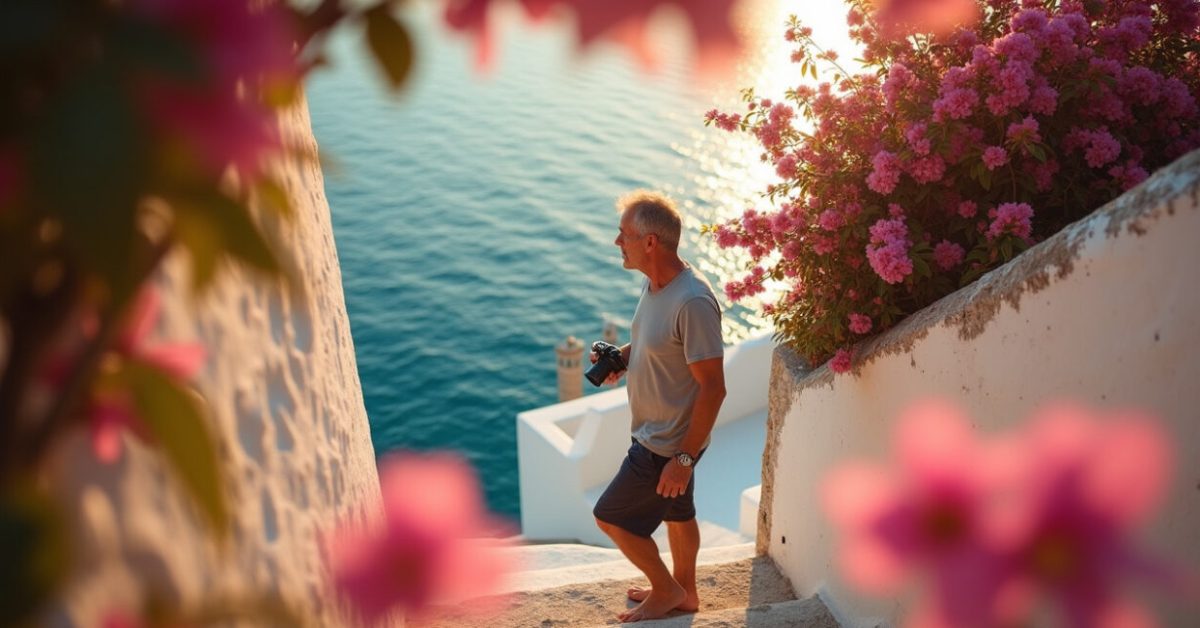

Blue water fills the frame, a whitewashed stairwell squeezes into the corner, and you have five minutes before light dies. Choosing which lens to pull from your bag decides whether that moment becomes a hero photo or a forgettable snap. Greek island lenses are not just gear choices — they are the viewfinder of your memory. Pack wrong and you’ll live with regrets. Pack right and every island walk becomes a sequence of keepers.
The Single Lens That Surprises Most Photographers
A 24–70mm or 35mm prime will cover more Greek island lenses use cases than you think. On narrow alleys, at tavernas, and on small ferries, that mid-range gives you both context and pleasing compression. It’s not the flashiest pick, but it’s reliable. You can shoot architecture at 35mm, seascapes at 24mm, and tight details at 70mm crop. Many pros call it the workhorse for islands. If you must travel light, start here.
Why Wide-angle Wins for Dramatic Seascapes and Tiny Alleys
Wide lenses change how space feels — they make the sea vast and alleys cinematic. A 16–24mm or 14mm brings foreground rocks, waves, and a chapel into a single dramatic frame. For architecture, they force you to frame with care to avoid distorted domes. Use strong foreground elements to anchor shots; otherwise the image looks empty. Greek island lenses in this class excel at sunrise and blue-hour shorelines. Bring a polarizer to cut reflections and deepen the sky.

The Underrated Power of Standard/normal Lenses for Storytelling
Standard lenses make images that look like what your eyes remember. A 35mm or 50mm renders perspective naturally. That matters when you want mood: a fisherman smoking by a blue door, a market stall of olives, a sunset over a harbor with boats close and people nearer. They force you to move with the scene. In practice, Greek island lenses in the normal range pull out emotion and candid moments better than extremes.
When Telephoto Becomes Your Secret Weapon
Telephoto lenses let you steal moments without being there — literally. A 70–200mm (or a 100–400mm for birding) isolates architectural details, compresses cliffs and buildings, and captures distant boats bobbing on blue. Use telephoto to pick patterns in tile roofs or catch a shy face at a distance. The downside: weight and shaky hands. Bring a monopod or raise ISO. Greek island lenses in the tele range are indispensable for details you can’t reach.
How to Mix Lenses for a Week Trip — A Practical Kit
Three-lens kits beat one-lens compromises for most island trips. A simple, mobile kit: wide (16–35mm), standard (35–50mm), tele (70–200mm). Swap the tele for a lightweight 24–70mm if weight is critical. Pack only what you’ll actually use during walks. Consider a small tripod for sunsets. Greek island lenses perform as a set: wide for seascapes, standard for people, tele for distant details. Keep cases padded and accessible — island paths are rarely flat.
Common Mistakes That Ruin Island Shots (and How to Avoid Them)
People bring too many lenses or the wrong ones and never switch. Top mistakes: overpacking heavy glass, ignoring prime lenses, not using a polarizer, and shooting from the obvious angle. Avoid these by planning three must-capture scenes per day: architecture, seascape, detail. Then choose lenses to match. A surprising comparison: shooters who plan lens use get twice the keeper rate of those who shoot every lens indiscriminately. Greek island lenses should help you simplify, not complicate.
The One Test to Run Before You Zip Your Bag
Do a five-minute “walk and shoot” test the afternoon before your first island day. Pick five frames: wide, mid, tight, a low-angle, and a detail. If you miss any because of lens choice, swap before you leave. That quick loop exposes blind spots: maybe your wide has too much distortion, or your tele lacks reach. Treat Greek island lenses like tools: you want fits for tasks, not a closet full of unused glass. This test saves time and disappointment.
For composition tips and tide info that affect seascapes, consult the National Oceanic and Atmospheric Administration tidal guides and local port notices. For architectural conservation rules and shooting permissions on heritage sites, see guidance from UNESCO and local cultural ministries.
Now decide: keep the workhorse, or risk weight for reach. Either way, choose lenses that make you want to walk farther. The islands reward curiosity — and the right glass.
Which Single Lens Should I Buy If I Can Only Choose One?
If you truly can only bring one lens, get a 24–70mm zoom or a 35mm prime. The 24–70mm covers wide to short-tele needs and handles architecture, street scenes, and some seascapes. A 35mm prime is lighter, faster in low light, and forces composition discipline. On Greek islands, you’ll appreciate mobility and the ability to shoot in tight alleys. Pick based on weight tolerance: want flexibility pick the zoom, want image character and light performance pick the prime.
Do I Need Image Stabilization for Island Photography?
Image stabilization helps, especially with telephoto lenses and shooting handheld at low light. On Greek island paths, you’ll often be moving and without a tripod. IS lets you keep shutter speeds lower without blur. For wide lenses, stabilization is less critical but still useful for video or dusk shooting. If your camera body offers good in-body stabilization, you can prioritize lens optics over IS. Either way, stabilization increases keeper rate when you can’t or won’t set up a tripod.
How Do I Handle Lens Cleaning Near Saltwater and Sand?
Salt spray and sand are the enemies of glass. Rinse gear only with a quick wipe — never submerge. Carry a blower, microfiber cloth, and lens brush. Keep your camera in a protective bag when not shooting. After long days near the sea, gently brush surfaces and change clothes to avoid transferring salt to your kit. For extended trips, use silica packs in your bag. These simple steps keep Greek island lenses working and avoid expensive repair bills from corrosion.
Are Prime Lenses Better Than Zooms on the Islands?
Primes often give better sharpness, wider apertures, and lighter weight. For portraits and low-light tavernas on Greek islands, primes shine. Zooms provide flexibility for changing scenes and save time swapping glass on narrow streets. The best choice depends on your style: if you value speed and reach, choose zooms; if you want image quality and discipline, choose primes. Many photographers combine a prime and a versatile zoom to get the best of both worlds.
What Filters Should I Pack for Island Shooting?
Bring a circular polarizer and a couple of neutral density filters. A polarizer cuts glare on water and saturates skies — crucial for Greek island seascapes. ND filters let you smooth waves and handle bright midday light for long exposures. Keep a small variable ND if you prefer convenience, but have fixed ND for the best quality. Also carry lens caps and a UV or clear protective filter if you’re worried about sand. Filters extend creative control without adding much weight.