

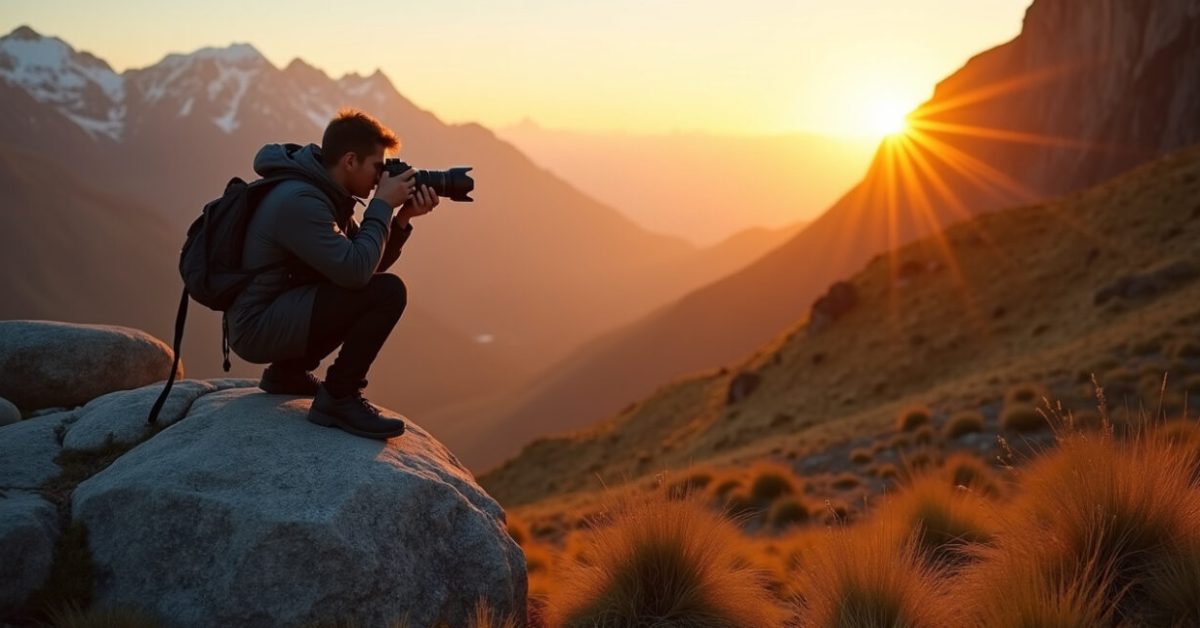

The sky already looks better than it did ten minutes ago. Warm light is slipping along ridgelines, and every rock suddenly has personality. That narrow window — the golden hour — is where landscapes stop being flat pictures and start feeling like memories. If you want dramatic depth, color, and texture without relying on post-processing, these seven practical techniques will change how you shoot that magic light.
1. Meter Like a Pro: Favor Highlights, Not Midtones
Expose for the highlights you want to keep. During golden hour the contrast between sunlit peaks and shadows is extreme. If your meter averages the scene, you’ll lose color in the highlights or crush the shadows. Instead, use spot or partial metering on the brightest part you care about — a sunlit cliff, a cloud rim, a bright leaf. Then underexpose 1/3–1 stop from that reading to keep color and recoverable shadow. Golden hour works because the highlights carry the warmth; protect them first.
2. Position for Texture: Light Across the Surface
Flat light kills texture. The secret of golden hour is angle. Put the sun at a low side angle to your subject so light grazes surfaces and reveals ridges, bark, and ripples. Move a few feet left or right. Often a minor shift changes a scene from flat to tactile. Side-lit scenes show depth; front-lit scenes look boring. On a beach, low side light makes sand patterns pop. On a mountain, it sculpts ridgelines. Use a tele lens to compress or a wide lens to emphasize foreground texture.

3. Use Exposure Bracketing to Capture Dynamic Range
Golden hour can exceed your camera’s native range. Bracketing is insurance. Take a -2, 0, +2 stop sequence and blend in post, or use in-camera HDR if you prefer speed. This keeps shadow detail without blowing the warm highlights. Bracketing also gives creative choices: a high-key look, a moody silhouette, or a balanced composite. Bracketing preserves the scene’s dynamic feel. It’s faster than fiddling with complex masks on your phone later, and it keeps you focused on composition while the light changes.
4. Balance Color Temperature with Intent
Golden hour’s warmth is seductive — but sometimes you want control. Shoot RAW and set white balance to daylight or cloudy to keep that warmth, or dial toward tungsten for a cooler look that emphasizes contrast. If the sun is behind clouds, push color temp slightly warmer to retain the golden feel. Decide whether the warmth is the subject or an accent. A canyon may need full warmth; a scene with green foliage can look garish if over-warmed. Consistent white balance across a bracketed set makes blending simpler.
5. Compose Around the Light, Not Just the Landmark
Most photographers place the sun or the landmark in the center and hope for magic. Better: compose for the way light moves through the scene. Look for leading lines the light will trace, silhouettes that gain rim light, and foreground textures that will catch the glow. Try a low camera position so foreground elements reflect warm tones. A great golden hour photo shows how light travels, not just where it lands. This shift in mindset turns ordinary scenes into layered stories.
6. Small Tweaks That Make a Huge Difference
Seven small moves, big payoff. Use a polarizer to deepen skies but remove it when you need max light. Stop down a bit for sharper foreground-to-background detail. Use back-button focus for quick recomposition. Add a subtle graduated ND filter when the sky is much brighter than the land. Tiny adjustments matter more during golden hour than at noon. They let you keep the drama without overprocessing. The goal is to capture the scene as you felt it — not as a digital clone.
7. What to Avoid: Common Mistakes That Ruin Golden Hour Shots
People ruin golden hour two ways: chasing the sun and ignoring basics. Mistakes to skip:
- Overexposing highlights — blowouts lose warmth.
- Centering the sun reflexively — leads to weak composition.
- Not bracketing when dynamic range is huge.
- Over-using a polarizer and killing warmth.
- Packing up early — the light often gets more interesting after the peak.
Don’t chase perfect light; shape it. Stay until the end of the window and experiment. One sunset I thought was done turned cinematic with five minutes of leftover glow — and that last frame became the keeper.
For technical background on dynamic range and metering, see resources like National Park Service photography tips and studies on visual perception at American Psychological Association. These sources help explain why the eye and camera diverge during golden hour, and how to use that to your advantage.
Golden hour gives you a short, powerful chance. Use it with intention — meter for highlights, move for texture, bracket for safety, and compose for how light travels. Do that, and your landscapes will stop looking like photos and start feeling like moments.
How Long Does the Golden Hour Actually Last?
The duration of golden hour depends on latitude, season, and weather, but typically it’s 20–60 minutes around sunrise and sunset. Near the equator it’s short; at higher latitudes it can stretch much longer in shoulder seasons. Cloud cover compresses or extends the usable light unpredictably. Plan to arrive at least 30 minutes early and stay 30 minutes after sunset or sunrise. That gives you time to scout, test exposures, and catch the subtle shifts that make the golden hour so valuable for landscapes.
Should I Shoot RAW or JPEG During Golden Hour?
Shoot RAW. Golden hour offers delicate color and a wide dynamic range that RAW preserves far better than JPEG. RAW retains highlight and shadow information and makes white balance adjustments safer. If you must deliver images immediately, shoot RAW+JPEG and use the JPEG for quick sharing while keeping RAW for final edits. RAW prevents banding in gradients and preserves the subtle warmth of golden hour. The extra file size is a fair trade for retaining the scene’s full depth and color.
Can I Use Filters During Golden Hour Without Losing Warmth?
Yes — carefully. A polarizer can deepen skies and cut reflections, but it also reduces light and can mute warm tones if overused. Graduated ND filters help balance bright skies with darker land and keep highlight detail. Use neutral-density filters when you need slow shutter speeds for motion, but be mindful that heavy ND stacks can alter color. Test one filter at a time and keep white balance consistent across exposures. That way you keep warmth while solving range problems.
What Focal Length Works Best for Golden Hour Landscapes?
There’s no single “best” focal length; it’s about intent. Wide angles (16–35mm) emphasize foreground texture and exaggerate depth, perfect for dramatic golden hour foregrounds. Telephoto lenses (70–200mm+) compress layers and make distant ridgelines glow together for a painterly effect. Often the most compelling approach is to bring both: a wide to ground the scene and a tele to isolate warm highlights. Walking the scene and trying different focal lengths is the fastest path to discovering what the light rewards.

How Do I Handle Moving Subjects During Bracketed Shots?
Moving subjects complicate bracketing because merging exposures can create ghosting. Use shorter intervals between bracketed frames, a higher shutter speed, or enable in-camera HDR that aligns frames. If you must blend manually, mask carefully around moving elements or keep one exposure as your base and blend only skies and foregrounds. Another option is to shoot the subject separately and composite it into a bracketed background. With fast light during golden hour, planning and speed are your best tools against motion issues.