

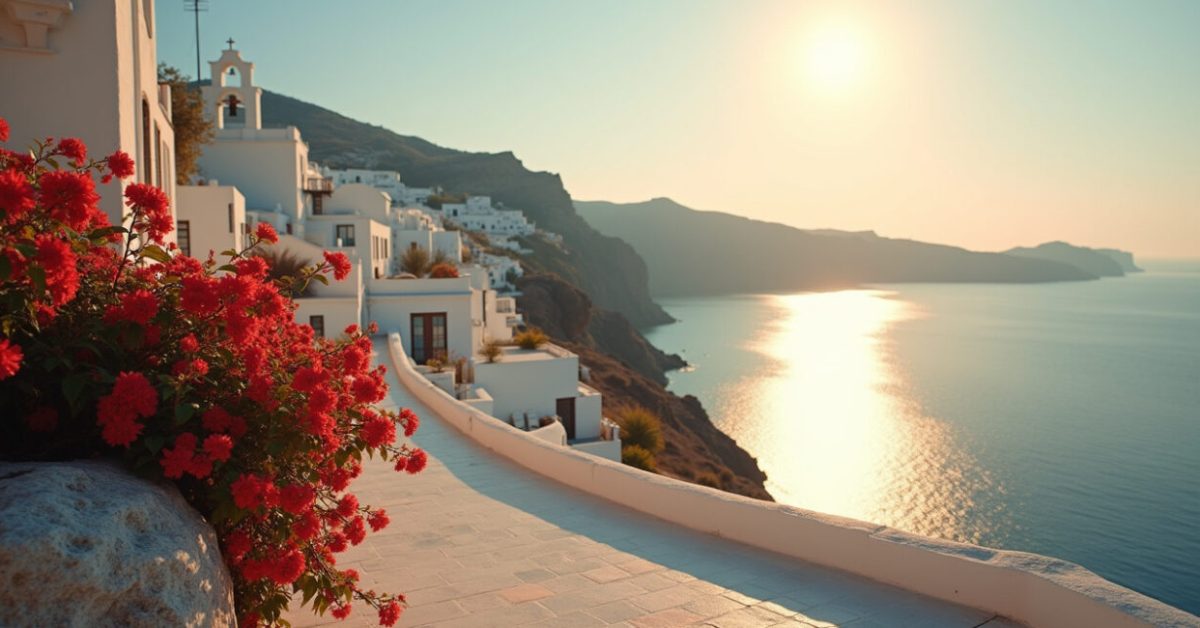

Salt on your lips, sun a hairline above the horizon, and that tiny white chapel perched like punctuation on a cliff — but your photo still feels flat. Composition tips for Greek vistas can fix that in one decisive click. Use foreground layers, clever lines, and a balance between sea and sky to turn a snapshot into something cinematic. Read this like a short masterclass: a few rules, quick tricks, and one visual trick you’ll use every time you shoot on the islands.
Layering Foregrounds: The Secret That Adds Instant Depth
Layering foregrounds will make a two-dimensional scene feel three-dimensional. Place rocks, flowers, or a worn wall within a few feet of the lens and let the midground and sea sit beyond. In Greek settings, bougainvillea, fishing nets, or terrace steps work wonders.
- Foreground: texture and scale (rocks, flowers)
- Midground: subject (chapel, boat)
- Background: sea and sky for context
These composition tips force the eye to travel. The result is depth without post-processing. Try a wide aperture to blur the closest element slightly — it keeps attention on the main subject while preserving a sense of place.
Leading Lines That Pull the Viewer Into the Scene
Leading lines are literal highways for the eye. In Greece, stairways, fences, rows of vines, and coastal roads become natural guides. Position them to start near a corner and lead toward your focal point, like a chapel, cove, or a lone fisherman.
Use composition tips to arrange lines so they converge or gently curve. Straight, harsh lines can feel mechanical; soft curves feel cinematic. This small change turns ordinary perspective into a visual journey.

Balance Sea and Sky: When Emptiness Becomes Composition
The amount of sky vs. sea changes the mood dramatically. Too much sky can feel like wasted space; too little can feel claustrophobic. For sunsets, give the sky more room. For rugged seas, prioritize the water. Count on the rule of thirds, but break it when the clouds or waves demand it.
These composition tips help you decide quickly. If the sky has interesting color or texture, let it dominate. If the sea has movement, place the horizon lower. Small horizon shifts change the emotional weight of the image.
Small Framing Tricks That Add Drama
Framing with doorways, foliage, or arches adds instant drama. Look for natural frames: a blue-painted window, a vine-wrapped arch, or an old boat hull. Use them to isolate your subject and give images a layered, cinematic feel.
- Frame tightly to emphasize details
- Frame loosely to suggest environment
- Mix frames with leading lines for strong composition tips
A quick tip: tilt your camera slightly when inside frames to avoid perfectly parallel edges — it feels more human and less staged.
Contrast and Color: Use the Greek Palette to Your Advantage
Color can be your compositional partner, not just decoration. The white-and-blue shorthand of the islands is powerful. Use contrasts — warm paint, cool sea, bright clothing — to draw focus. Composition tips include placing contrasting color near your subject to pull the eye.
Think of color as a magnet. A red bucket on white steps or a yellow door against a cobalt sky will anchor the scene. Don’t over-saturate; subtle contrast often reads as more cinematic than loud color.
What to Avoid: Common Composition Mistakes
Knowing what not to do speeds improvement more than practicing tricks endlessly. Avoid these common errors when applying composition tips in Greek vistas:
- Centered subjects that kill movement — unless you mean balance.
- Clipping limbs or cutting off architectural features awkwardly.
- Using one flat plane with no foreground or middle ground.
- Ignoring the horizon — it should be straight unless intentional.
One surprising comparison: a photo with no foreground is like a stage with no props. It looks empty. Add a pebble, a plant, or even a person’s shoulder in the corner — the scene immediately breathes.
Mini-story: A Single Trick That Changed an Entire Shoot
On a wind-scoured morning in Santorini, I framed a tiny chapel through a low white wall. The original shot was polite and flat. I crouched, placed a stray almond branch in the near frame, and moved slightly left. Suddenly, the chapel sat between the branch and the sea, and the image read like a scene from a film. That one small framing decision used three composition tips at once — layering, framing, and line — and it saved the whole series.
For technical context on horizons and visual perception, see research on visual composition from NCBI and landscape photography guidelines from reputable photography institutions like National Geographic. These sources back why our eyes prefer layered scenes and guided lines.

Try these composition tips on your next Greek shoot: layer first, then find lines, balance the sky and sea, and finish with a tiny frame. If you do one thing differently, let it be adding a foreground — it’s the fastest path from good to cinematic.
How Do I Choose the Best Foreground Element?
Pick something that adds texture and scale without stealing the scene. In Greek settings, look for flowers, stones, painted walls, or a weathered boat. Keep it simple: a single element close to the camera is often more effective than several competing objects. Use a shallow depth of field if the foreground is detailed; that keeps attention on the main subject while preserving the sense of depth. Test by moving the element slightly and watch how the composition changes.
When Should I Prioritize Sea over Sky in the Frame?
Choose the sea when it has motion, reflections, or distinct texture you want to show. Rough waves, sun glinting on water, and boats create interest that deserves more space. Place the horizon higher when the sea is the star. Conversely, give the sky more room during colorful sunsets, dramatic clouds, or low-light transitions. The decision depends on where the visual story is happening. Trust your eye and adjust the horizon to emphasize what feels alive in the scene.
Which Focal Length Works Best for Greek Vistas?
There’s no single best lens, but certain focal lengths help with composition tips. Wide angles (16–35mm) emphasize foregrounds and depth; they’re ideal for layered scenes and dramatic architecture. A 35–50mm lens gives a natural perspective and suits street scenes. Telephoto (85–200mm) compresses planes and isolates subjects like distant chapels or cliffs. Choose the lens that supports the story: wide for place, telephoto for intimacy. Walk a bit; small position changes matter more than swapping lenses.
How Do I Use Leading Lines Without Making the Photo Feel Forced?
Keep lines organic and let them start near a corner or edge. Avoid slicing the frame with a line that appears to be staged. Use natural elements — paths, rows of houses, fences — and align them so they guide the eye toward your subject. Vary the line’s strength: a bold road for dramatic pull, softer curves for a gentle flow. If a line looks staged, reposition and shoot again; often a small angle change makes it feel effortless and natural.
Can I Apply These Composition Tips with a Smartphone?
Absolutely. Smartphones now have excellent lenses and intelligent metering. Use the same rules: add a foreground element, look for leading lines, balance sea and sky, and use framing. Tap to lock exposure on your subject and try portrait mode or a wide lens if available to create depth. Move closer to foreground elements to exaggerate depth, and steady your phone on a small wall or stone to avoid shake. These simple moves produce cinematic results even on a phone.