

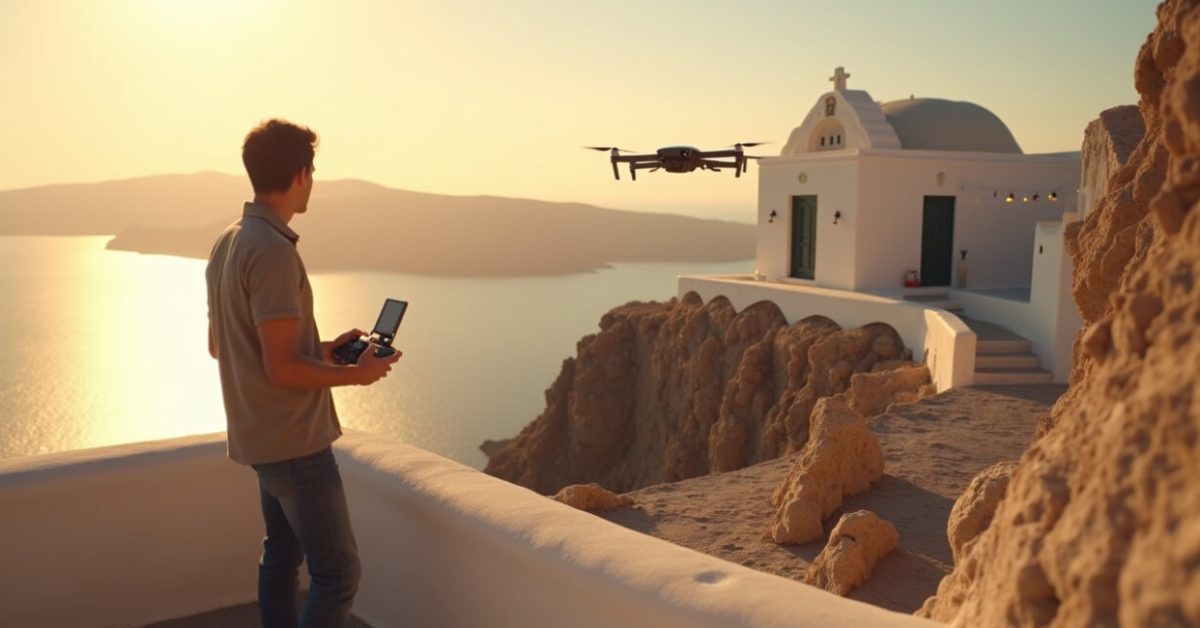

I was hovering 30 meters above a tiny white chapel in Santorini when two things hit me at once: the wind changed, and a ranger radioed that I was over a restricted site. That single moment contains the whole deal with shooting drone Greece — beauty, urgency, and rules that can cost you more than a fine. Read this now if you plan to fly: you’ll get legal must-knows, practical battery and wind tips, and creative angles that actually make Greek islands and ruins sing from the air.
What You Must Know About Rules Before You Lift Off
Greece treats drones like serious equipment, not toys. The law requires registration for many drones and, depending on weight and use, a permit. Tourist flights over archaeological sites and national parks are tightly restricted. Drone Greece pilots should check the Hellenic Civil Aviation Authority for current rules and local municipal bans before takeoff. Ignoring this can mean fines, gear seizure, or being escorted off an island. Think ahead: permissions often take days, not hours.
The No-fly Map: Where You’ll Get Stopped, Fast
No-fly zones in Greece are not optional. Military bases, power plants, airports, and many archaeological sites are forbidden. Some areas near islands have seasonal restrictions for bird nesting. Use official maps and apps, and cross-check with local port authorities if you’re flying from a boat. A common mistake is relying on generic global apps — they miss temporary NOTAMs and local municipal rules. For verified restrictions, consult Hellenic Civil Aviation Authority and regional island offices.

Battery Life and Wind: The Silent Shoot Killer
Wind drains battery life faster than you expect. A 20-minute flight in calm conditions can become a 10-minute fight in 20+ km/h gusts. In Greece, thermals off cliffs and sudden Aegean gusts are common. Plan flights with a 50% safety margin on battery, and always factor in return-to-home buffer. Bring extra fully charged batteries, a car charger, and a power bank. If you’re flying between islands, consider swapping batteries instead of relying on charging at guesthouses.
Composition That Turns Ruins and Islands Into New Stories
See the site no one else is showing. Think verticals: shoot a narrow alley down to a blue dome, place ruins off-center to reveal sea lines, or use low, sweeping arcs to expose layers — archaeology, people, sea. For islands, contrast white architecture with sharp shadows at golden hour. Use height to show scale: start low and rise slowly to reveal context. Drone Greece is about telling where something sits in the world, not just what it looks like.
Creative Angles: 8 Shots That Work Every Time
Here are reliable drone Greece frames that beat generic panoramas:
- Low arc reveal: start behind a cliff and sweep up to reveal a hidden cove.
- Bird’s-eye grid: straight-down on white rooftops to show patterns.
- Leading-waterline: align shoreline to lead the eye to a landmark.
- Temple slice: crop ruins along a diagonal to highlight layers.
- Motion-blend pass: slow shutter on camera, steady drone speed for silky waves.
- Scale anchor: include a tiny human or boat to show size.
- Shadow play at noon: use harsh light for geometry on white buildings.
- Golden-hour orbit: slow rotation around a landmark at sunset.
These work across islands and sites. When you fly drone Greece, aim for an emotional reveal, not a checklist image.
Errors That Will Cost You Time, Money, and Footage
Most pilots fail for avoidable reasons. Common mistakes: skipping local permits, underestimating wind, flying low over archaeological digs, and not checking temporary NOTAMs. Another big one: relying on single-battery flights for long missions. Expect unexpected ferry delays, extra walk time to launch sites, and officials asking for documentation. Avoidance starts with a preflight checklist: permits, NOTAM check, battery reserve, insurance, and local contact details. Treat each shoot as an expedition.
Quick Checklist for a Safe, Legal, and Photo-ready Flight
Before you press record, follow this condensed routine:
- Check HCAA rules and local municipal bans.
- Verify NOTAMs and temporary restrictions.
- Pack extra batteries, chargers, and a compass or GPS pack.
- Plan flight windows for golden hour and low wind.
- Have civil ID, drone registration, and insurance ready.
- Respect archaeological buffers and local guides.
Do this and you’ll avoid most headaches. When you fly drone Greece with discipline, your footage will look effortless.
For historical and conservation context when planning missions, consult archaeological rules at regional ephorates and reference environmental guidance such as EU environment resources for protected areas. These sources help you align creative ambition with legal reality.
Final Note That Sticks with You
The best aerial photo is the one you’re allowed to keep and publish. In Greece, respect is part of craft: it protects sites, your equipment, and your ability to shoot again. Fly smart, plan early, and aim for angles that show place and story — not just pretty pixels. If you remember one rule: permission before altitude.
Can I Legally Fly over Ancient Ruins in Greece?
Short answer: usually no without permission. Many archaeological sites are protected by law and require explicit authorization from local ephorates or cultural ministries. Even if a site looks abandoned, excavation boundaries and conservation zones can extend well beyond visible ruins. If you plan commercial work, permits are almost always mandatory. For hobbyists, local municipal rules and HCAA restrictions still apply. Always check with the local archaeological service and have written permission before launching near any historic site to avoid fines and confiscation.
How Do I Check for Temporary Flight Restrictions and NOTAMs in Greece?
Use official aviation channels and apps that pull NOTAMs in real time. The Hellenic Civil Aviation Authority publishes temporary restrictions; regional airports and military zones often issue ad-hoc notices. Local port authorities or island municipalities can also have short-term bans for events or security. Relying on a single consumer drone app is risky—cross-check with government sources. If in doubt, contact the nearest airport or HCAA office directly. A quick call can save a long fine and a lost shoot.
What Battery Strategy Works Best for Island Hopping Shoots?
Treat each drone battery like a limited ticket: plan flights with at least a 50% reserve for return and contingencies. For island hopping, bring multiple fully charged batteries and a portable charging kit. If you can’t charge between islands, rotate batteries so none drop below safe storage charge. Avoid tightly planned single-battery sorties. Also monitor temperature: heat shortens battery life and cold drains capacity. Carry a small insulated bag to keep batteries near room temperature and prolong usable flight time on each mission.

How Should I Handle Wind and Thermal Lifts Near Cliffs and Beaches?
Expect unpredictable gusts near cliffs and over warm land. Thermals can toss a drone upward quickly, changing exposure and altitude. The practical fix: start low and do short test passes to read conditions, then increase altitude slowly. Use sport mode only for emergency maneuvers; otherwise fly in GPS/attitude-stable modes. Plan for conservative altitudes and wider clearance from cliff edges. If winds exceed manufacturer limits or you lose smooth control, land and reschedule. Safety beats one risky, cinematic pass.
What Are Respectful Compositional Rules for Photographing Sacred or Private Sites?
Respect equals access. Keep distance from worshippers, ceremonies, and fenced-off areas. Avoid low passes that invade privacy or disturb people. Use composition that includes context—show how a chapel sits within a town—rather than intrusive close-ups. If locals ask you to stop, do it. Always seek permission when possible; many communities welcome respectful documentation and may even suggest angles. Respectful shooting keeps you welcome and often leads to better, more authentic images than stealthy approaches.