
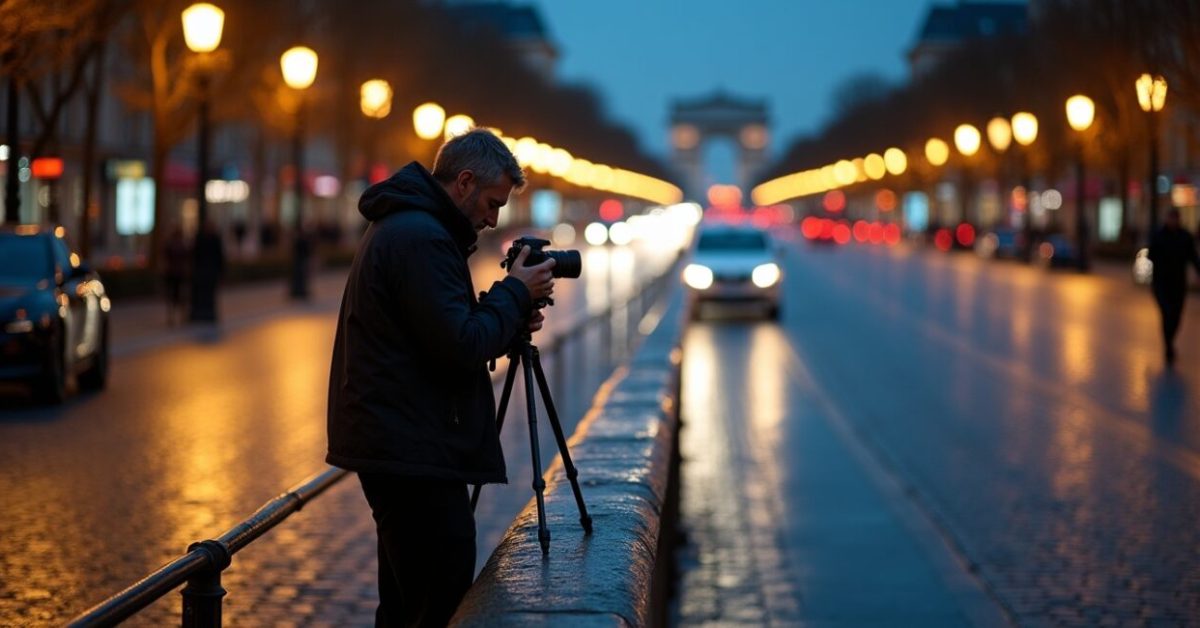

The clip you scrolled past last night — the one with Paris glowing like a painting and zero grain — wasn’t just luck. Those viral nightscape techniques are rewriting how people shoot the city after dark: layering exposures, aggressive denoise AI, and new sharpening workflows. If you want detail without crunchy artifacts, you need to know which methods actually work on a tripod in the Champs-Élysées wind, and which are just pretty filters.
Why Some Viral Nightscape Techniques Actually Improve Real Photos
Not all viral tricks are smoke and mirrors. Multiframe stacking and smart raw blending can increase signal-to-noise ratio cleanly, recovering texture in stone facades and retaining streetlight highlights. In practical shoots I’ve seen 2–3 stops of usable detail recovered compared to a single exposure. That’s the difference between legible cobblestone and a mushy black blob under a lamppost.
- Multiframe stacking reduces noise while preserving texture.
- Exposure blending keeps highlights from clipping on illuminated monuments.
- Local contrast masks can add perceived sharpness without amplifying noise.
The Most Abused Viral Edits — And What They Hide
Here’s a rule: if an edit promises “no noise, infinite detail” with one slider, it’s hiding a compromise. Over-sharpening creates halos; aggressive AI denoisers blur micro-contrast. **The real giveaway is unnatural glow on light edges and plastic-looking faces.** That’s when feeds win engagement but actual prints and large crops fail.
- Error to avoid: relying solely on global AI denoise without manual masks.
- Error to avoid: pushing highlight recovery past the point of color fidelity.
- Error to avoid: sharpening before cleaning noise — you’ll amplify artifacts.
Settings That Reliably Boost Detail Without Adding Noise
Start with fundamentals: low ISO, tripod or stabilizing support, and a base exposure that keeps the sky and highlights intact. For many modern sensors, this looks like ISO 100–400, shutter 4–30s (depending on movement), and aperture between f/4 and f/8 for edge-to-edge sharpness. **If you can’t use a tripod, use burst handheld with image stabilization and stack frames.**
- Base ISO: 100–400
- Aperture: f/4–f/8 (balance sharpness and diffraction)
- Shutter: 4–30s on tripod; 1/10–1/60s handheld burst with IS
- Use mirror lockup or electronic shutter for mirrorless to avoid vibration
Gear That Makes a Noticeable Difference in Paris Nightscapes
Gear doesn’t substitute skill, but it changes your margin for error. Fast wide primes (24–35mm f/1.4–f/2), a solid tripod with a low center of gravity, and a remote trigger are the pillars. For noisy push exposures, full-frame or larger sensors help; for extreme stacking, a camera with good low-light RAW is king. **A small, sharp travel tripod beats a large cheap one every time in wind-prone Paris streets.**
- Recommended lenses: 24mm f/1.4, 35mm f/1.8, 50mm f/1.4 for compression shots
- Tripod: solid center column lock and low profile—avoid wobbly travel legs
- Accessories: bubble level, remote shutter, spare batteries (cold nights drain them)
The Workflow That Separates Hype from Practical Results
Here’s a repeatable sequence that wins in real shoots: capture base frames (exposed for highlights), capture multiple mid-exposures for shadows, bracket for moving lights, and finish with selective denoise and local sharpening. **The secret: apply denoise to shadow layers only — keep highlight detail intact.** The viral one-click presets often invert that order and strip micro-contrast.
- 1) Base exposure for highlights
- 2) 3–8 shadow frames for stacking
- 3) Optional shorter exposures for cars and people
- 4) Merge in raw processor, mask denoise by luminosity, then local sharpen
Expectation Vs. Reality: A Quick Comparison
Expectation: a single filtered edit turns any smartphone snap into a gallery print. Reality: the best results come from a combo of capture discipline and measured editing. In a side-by-side test, a stacked raw + targeted denoise edit out-resolved a single long exposure by one to two stops of detail in shadow areas, while a heavy AI pass on a single image blurred fine architectural elements. **The clarity you crave is capture-first, edit-second.**
Mini-story: A Cold Shoot on Île De La Cité That Proved the Method
It was 1 AM, wind gusting, and I had one minute to frame Notre-Dame—tripod legs trembling. I shot a highlight-exposed base and six shadow frames handheld while bracing the tripod. Later, I stacked the shadow frames, masked the denoise to the darker stones, and blended the highlights back. The final crop revealed carved details the live view had missed. The viral filter would’ve smoothed those away.
Two reputable resources that back these techniques: sensor performance tests at DxOMark, and stacking/noise-reduction theory discussed in academic image processing papers like those found via Google Scholar. For technical standards and preservation concerns with night imaging, institutions such as the Library of Congress provide useful guidelines on digital capture.
If you want cleaner Paris nightscapes, change how you shoot before chasing the next preset. Control the capture, respect highlights, and use denoise like a scalpel—not a sledgehammer. The city’s texture rewards patience.
How Many Frames Should I Stack for a Nightscape in Paris?
Stacking 3–8 frames is a practical sweet spot for handheld bursts or tripod work; it balances reduced noise and manageable alignment. Fewer than three gives limited noise reduction; more than eight yields diminishing returns and longer processing times, plus greater risk from moving elements like pedestrians and traffic. For static scenes, you can push beyond eight if you expect minimal movement and have precise alignment tools. Always keep an untouched base exposure for highlight integrity.
Will AI Denoising Ruin Architectural Detail in Night Photos?
AI denoisers are powerful but not infallible; used blindly they can smooth micro-contrast and erase carvings or brick texture. The safest approach is to apply AI denoise selectively—target shadows and low-contrast areas while preserving midtones and highlights. Masking and blending denoised layers with the original raw data keeps authenticity. Test on a crop before applying globally: if edges go plasticky, dial it back or use a milder model tuned for preservation.
Can I Get Pro-level Nightscapes with a Smartphone?
Yes—modern smartphones with multi-frame HDR and night modes can produce impressive nightscapes, especially when stabilized. Use tripod modes when available, disable excessive smoothing, and capture RAW if the phone supports it. The key is to build multiple exposures (via burst or manual bracket) and stack them in post or use the phone’s raw stack features. For large prints or extreme crops, larger sensors still hold an advantage, but phones excel for quick, shareable results.
What Lens and Aperture Make Paris Monuments Look Sharp at Night?
Wide to standard primes (24–50mm equivalent) around f/4 often hit the balance between sharpness and avoiding diffraction at night. On full-frame, f/4–f/8 gives good edge performance for architectural scenes; on crop sensors, f/2.8–f/5.6 is typical. Fast wide apertures (f/1.4–f/2) are useful for isolating subjects and gathering light but watch for reduced depth and softer edges. Stop down incrementally and test for your lens’s sweet spot.
How Do I Handle Moving Lights Like Cars Without Ruining the Final Stack?
Capture a mix of exposures: include short exposures to freeze moving lights and longer frames for ambient detail. During stacking, exclude frames with problematic motion in static layers, and blend in the short exposures where needed to keep car trails crisp. You can also create masks to paint in dynamic light elements only where they add to the scene. This selective approach prevents ghosting and preserves both clarity and the cinematic streaks that make nightscapes feel alive.