

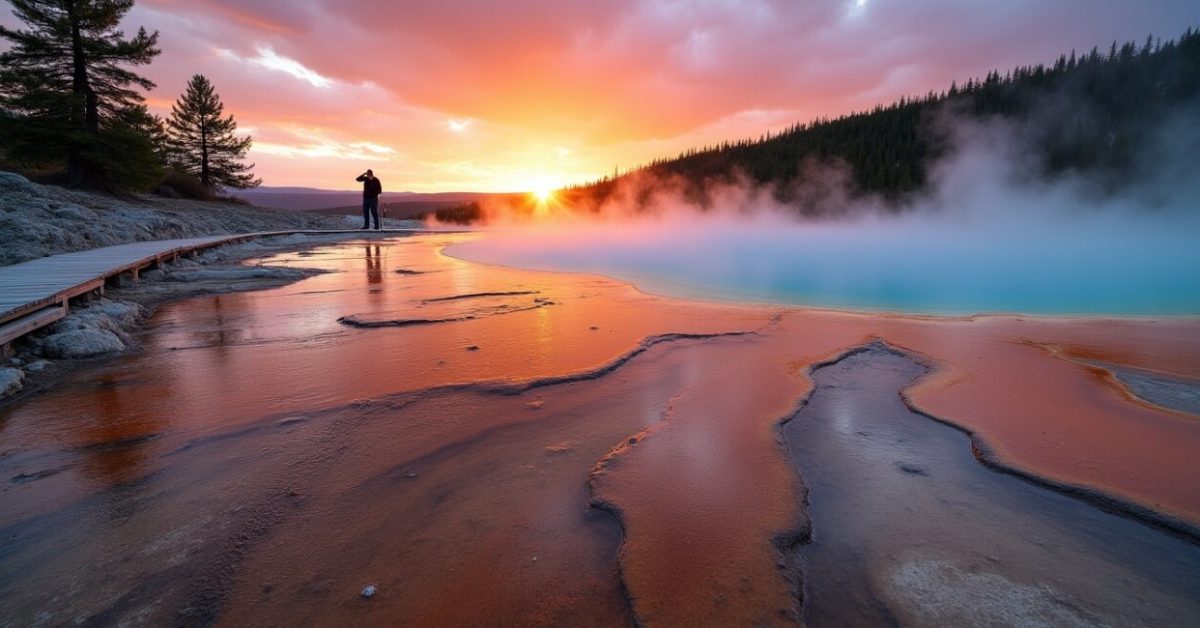

There’s a moment when steam, sulfur, and sky collide in a blaze of color—Yellowstone sunrise captures that fleeting spectacle. Photographers and nature lovers chase it for the light, the palette, and the story each dawn tells.
At Artist Point and Grand Prismatic, composition, timing, and new 2025 vantage angles reveal saturated reflections, layered steam, and unexpected foregrounds. This guide explains how to capture those colors with fresh perspectives and reliable tech tips.
Why Yellowstone Sunrise Feels Unlike Any Other Dawn
Emotional Pull of Early Light
Sunrise in Yellowstone awakens the senses with rising steam, warming hues, and the hush of a park before crowds arrive.
The palette from soft pastels to intense oranges makes Artist Point and Grand Prismatic iconic for anyone chasing color and mood.
Geothermal Drama and Visual Storytelling
Thermal pools, mineral terraces, and steam plumes create dynamic layers that transform with each minute of sunrise.
Capturing these elements tells a story of time, chemistry, and the park’s raw, shifting beauty.
Best New 2025 Composition Angles at Artist Point
Foregrounds That Add Depth
Use warm rocks, foliage, or rim textures to lead the eye toward the canyon and sky, creating stronger emotional resonance.
Low angles accentuate steam ribbons and canyon scale while keeping the sunrise colors dominant in frame.
Balancing Canyon Rim and Sky
Position the horizon low to emphasize the sky’s gradient and let the canyon silhouette show contrast and texture.
Include a subtle reflection or a silhouetted tree for scale to make compositions feel intimate and vast simultaneously.
- Scout rim points 30 minutes before sunrise for best light adjustments.
- Prefer a tripod and remote shutter to avoid blur in long exposures.
- Shoot in RAW to preserve highlight and shadow detail for post-processing.

Fresh Perspectives for Grand Prismatic at Dawn
High Vantage Versus Low Rim Shots
Overhead angles reveal the concentric colors of Grand Prismatic, while lower rim shots emphasize texture and steam movement.
Combine wide-angle and telephoto frames to document overall pattern and intimate mineral detail in separate sequences.
Using Steam as a Compositional Element
Anticipate steam shifts and wait for moments when plumes backlight into golden veils for dramatic contrast.
Timing is crucial—those golden edges often last only a few minutes during sunrise transitions.
Gear, Camera Settings, and Composition Checklist
Essential Gear for Crisp Sunrise Images
Bring a sturdy tripod, wide-angle lens, polarizer, and ND filters to manage highlights and capture long exposures.

A remote release and spare batteries are crucial in cold, early-morning conditions to avoid missed frames.
Camera Settings That Work Reliably
Start at ISO 100–200, aperture f/8–f/11, and bracket exposures to capture highlight-to-shadow range for HDR or blended edits.
Use manual focus or focus-stack for sharp foreground-to-background clarity when incorporating rim details and thermal pools.
| Scenario | ISO | Aperture | Shutter |
|---|---|---|---|
| Wide sunrise panorama | 100 | f/8 | 1/60–1/125s |
| Long exposure with steam | 100 | f/11 | 1–5s (ND as needed) |
| Telephoto detail | 200 | f/5.6 | 1/250–1/500s |

Compositional Tricks to Amplify Color and Mood
Layering and Leading Lines
Use terraces, steam bands, and canyon rims as natural leading lines to guide the eye toward color transitions.
Layer foreground elements with midground steam and vivid sky to create depth and emotional pull in each frame.
Color Contrast and White Balance Choices
Warm white balance emphasizes golden dawns; cooler tones retain the blue steam contrasts against orange skies for drama.
Bracketing white balance or shooting RAW gives flexibility to choose the strongest emotional rendition in post.
- Arrive early and scout compositions before sunrise.
- Set base exposure and bracket three frames at ±1–2 EV.
- Switch between wide and telephoto lenses for variety.
- Lock down composition, then wait for peak steam and color moments.
- Review histogram and adjust to preserve highlights.
Practical Safety, Timing, and Access Tips
Park Rules and Safe Viewing
Stay on boardwalks and marked trails; thermal areas are fragile and dangerous—respect closures and signage for safety.
Early arrival reduces crowd interference and helps preserve quiet, allowing more meaningful compositions at sunrise.
Timing and Seasonal Considerations
Summer yields earlier sunrise and more steam backlighting; spring and fall offer cooler air and crisper colors with fewer visitors.
Check sunrise times, weather, and park alerts; fog and wind drastically change how colors and steam behave in each session.
- Check National Park Service updates before travel: NPS Yellowstone
- Consult USGS for geothermal activity advisories: USGS Yellowstone
- Review local weather forecasts early for wind and cloud trends.
Post-processing: Reveal the Colors You Saw
Raw Editing Workflow
Start with exposure and white balance; recover highlights and lift shadows to restore midtone color gradations from sunrise.
Selective contrast and vibrance adjustments bring out mineral rings without oversaturating skin or sky tones.
Advanced Color Grading Tips
Use HSL sliders to isolate orange and cyan shifts, enhancing the scene’s natural chemistry and preserving subtle gradients.
Layer local adjustments for steam edges and foreground textures to keep focus on color transitions and emotional impact.
Conclusion
Yellowstone sunrise at Artist Point and Grand Prismatic offers an unmatched palette when approached with fresh 2025 angles, careful timing, and respectful practices. The colors you capture will tell a story of place, light, and geology.
Return often, refine compositions, and let the morning light reveal new details—each dawn can become your best frame yet.
Faq
When is the Best Time to Photograph Yellowstone Sunrise at Artist Point and Grand Prismatic?
The optimal window is roughly 20–40 minutes before and after official sunrise, when low-angle light backlights steam and intensifies colors. Arrive early to scout foregrounds and secure a stable tripod location. Seasonal variations change exact timing and steam density, so check forecasts and park alerts.
What Lens and Settings Work Best for Capturing Grand Prismatic’s Colors?
A wide-angle lens captures the entire concentric pattern while a mid-telephoto isolates bands of color. Start with ISO 100–200, aperture f/8–f/11, and bracket exposures. Shooting RAW preserves color detail, giving flexibility to balance highlights and shadows in post-processing.
Are There Safety Concerns When Composing Near Thermal Features at Sunrise?
Yes—thermal areas are hazardous and fragile. Always remain on designated boardwalks and trails, obey signage, and respect closures. Maintain distance to protect yourself and delicate microbial mats that produce vivid colors visible during sunrise and avoid causing long-term damage.
How Can I Avoid Crowds and Still Get Clear Shots at Artist Point?
Arrive at least 45–60 minutes before sunrise to scout and secure a vantage point. Park during shoulder seasons or weekdays for fewer visitors. Patience and small composition shifts often yield unique frames that bypass the standard crowded angles.
Which Authoritative Sources Provide Updates on Yellowstone Conditions and Safety?
Consult the National Park Service Yellowstone pages for closures and rules, and the USGS Yellowstone Volcano Observatory for geothermal activity and scientific updates. Combining both sources ensures safe, informed planning for sunrise shoots and respectful visitation.